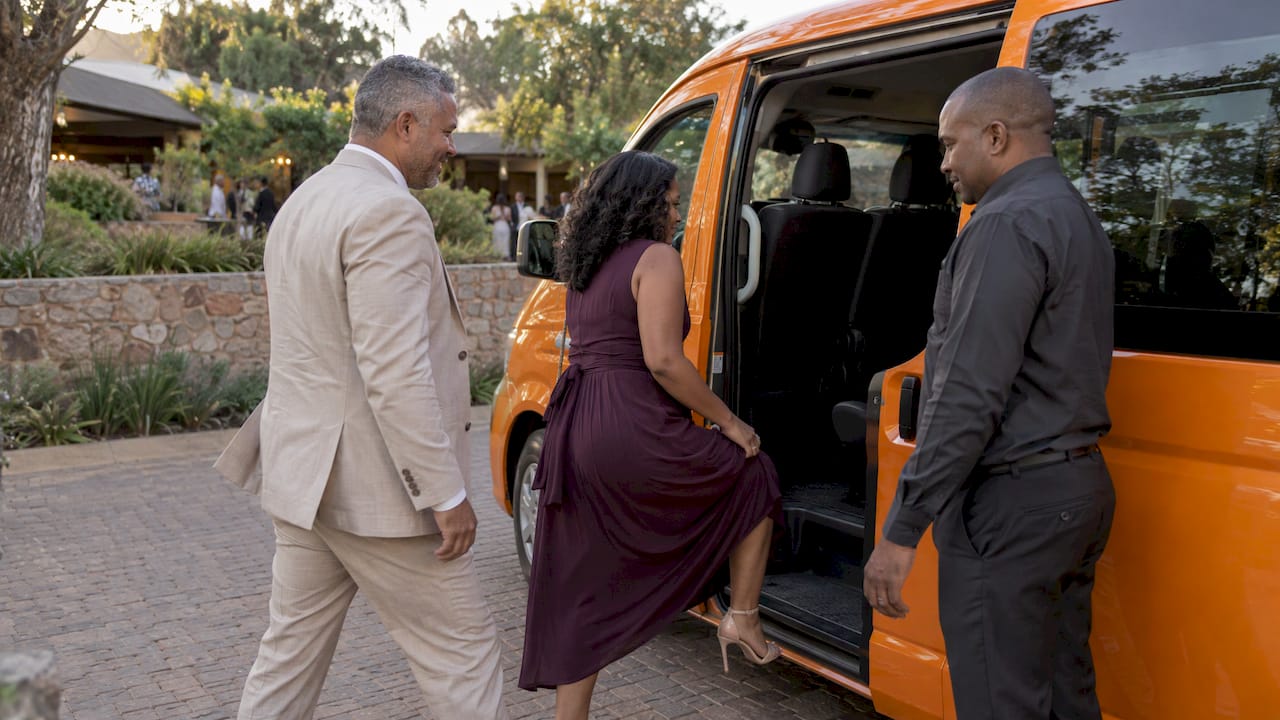
Good wedding guest transport is a fixed timetable, the right number of seats and a driver who is legally allowed to carry your guests, all agreed in writing before the day. If you are planning a wedding in or around Johannesburg, we run wedding transport with vehicles from sedans up to 22-seater buses, so one booking can cover the bridal party and the guests who should not be driving home.
This guide takes you through the planning in the order that works: the end of the night first, then seats, schedule, safety checks and cost.
TL;DR
- Plan backwards: start with how guests get home at the end of the night, then work out the arrival runs.
- Count the guests who have no car or should not drive, then decide how many vehicles you need running at once.
- A guest shuttle is a timetable, not a single hired car: fix the pickup points, the frequency and a last departure.
- By law, anyone carrying passengers for reward needs a professional driving permit (PrDP) and a roadworthy vehicle with a valid disc.
- Get the vehicle count, seating, schedule, pricing basis and breakdown plan in writing.
Table of Contents
- Start with the last departure, not the first arrival
- What wedding guest transport actually is
- Step 1: Count who actually needs a seat
- Step 2: Choose pickup points and write the timetable
- Step 3: Check the driver and vehicle are legal
- Step 4: Understand what drives the cost
- Step 5: Get it in writing
- Step 6: Plan for the guests arriving by air
- What we think about wedding transport
- Book your wedding guest transport with us
- A week-before checklist
- FAQ
- Sources
Start with the last departure, not the first arrival
Most couples think about the bridal car first and about the guests much later. Gavin Ruschin, a South African wedding planning writer, argues that transport is usually planned backwards: the real problem is how guests get home after drinking at a venue with no taxi rank, so the plan should begin at the end of the night.
That advice is worth following. Ask three questions before anything else:
- What time does the last guest need to leave, and where are they going? A hotel, a guesthouse, a home across town?
- How many of them will have been drinking?
- Is there any way home from the venue other than a vehicle you arrange?
If the venue is a farm, a wine estate or a lodge outside the city, the third answer is often no. Ride-hailing apps work reliably inside Johannesburg, Pretoria and Cape Town but far less reliably at a venue an hour outside them, according to the same Johannesburg transport guide. The guide also notes that a dirt road that is fine in April can be hard going after rain in December, which matters for the size and type of vehicle you book for a rural venue.
A booked shuttle removes that uncertainty. Your guests do not need to find a ride, wait for a driver who cannot find the gate, or decide whether they are fit to drive.
What wedding guest transport actually is
It helps to separate two things that get confused.
Wedding car hire is one vehicle for the couple, sometimes the wedding party, usually with photo stops and standby time.
A guest shuttle is a scheduled vehicle, usually a minibus or small bus, that moves guests between one or two fixed points. Typical pairs are an accommodation block and the venue, or a central pickup in town and a venue further out. It is built around a timetable rather than a single hired car.
Many weddings use both. The couple travels in one car, and a minibus or bus runs the guest loop. If you book with us, our private transport page covers executive, corporate and group trips, and the wedding service sits alongside it.
Step 1: Count who actually needs a seat
Do not count your whole guest list. Count the guests who do not have their own transport or should not be driving. Ruschin & Co suggests this as the starting number, and it is the right one because it keeps you from paying for empty seats.
A quick way to get there:
- Take the total guest count.
- Remove local guests who will drive themselves and are happy to arrange their own lift.
- Remove children who travel with parents who are driving.
- What remains is your passenger number, and you should add a small buffer for plus-ones who confirm late.
A shuttle earns its cost when it replaces a real problem: guests without cars, a venue far from where they are sleeping, or an evening where nobody should be driving. It matters less when guests are scattered across a city in their own cars. In that case a shuttle can end up a half-used, confusing extra, so match the service to the problem you are solving.
Worked example. You have 90 guests. Forty are staying in a Sandton hotel, 20 are local and driving, and 30 are family arriving from out of town who have booked a guesthouse nearby. Your passenger number is 70. A single 22-seater running back and forth would need at least four trips to move 70 people in one direction, which takes time you may not have before the ceremony. Two vehicles running at once, each making two trips, gets everyone there with margin to spare.
This is the principle Ruschin & Co applies: a single shuttle running every twenty minutes often covers a smaller wedding, while a larger one may need two vehicles running at once rather than one running twice as often. The reason is simple. A late bride, a slow photograph session or a traffic delay compresses the window, and two vehicles absorb that better than one doing laps.
Step 2: Choose pickup points and write the timetable
The fewer pickup points, the more reliable the schedule. One or two is ideal: the hotel lobby where most guests are staying, and perhaps one central meeting point.
Build the timetable like this:
- Work back from the ceremony. Guests should arrive at least 30 minutes before the start, so the final arrival run needs to land well before that. Add a buffer for loading.
- Set the frequency. For a short route, a departure every 20 minutes is workable. For a longer one, fewer, larger runs work better.
- Fix the return times. Choose two or three set return departures, for example after the formal dinner, mid-party and a final run. Then publish a last departure that does not move.
- Decide who is on which run. Put older relatives and families with small children on the early return.
The last departure is the line that protects you. Without one, the driver waits for a party that never ends, the cost climbs, and guests are left unsure when the last ride leaves.
Tell guests the plan before the day
A timetable only works if guests know it. Put it on the wedding website or the printed invitation, and repeat it on a small card in each hotel room or in the welcome pack. On the night, a nominated person, such as a groomsman or the planner, should have the schedule and the driver’s number, and should announce each departure. It is the same idea the City of Cape Town applies to larger events: its event transport guidance says plans should state routes, pickup and drop-off points, schedules and how attendees are told.
Step 3: Check the driver and vehicle are legal
This is the part couples overlook, and it is the one that matters if something goes wrong.
Under the National Road Traffic Act, as summarised in the Department of Tourism’s legislation compendium, a person who conveys people for reward must hold a professional driving permit, kept in the vehicle. The vehicle must be roadworthy with a valid roadworthy disc displayed, and the operator must keep proper control over the driver and run operations with due care for public safety.
There is also an operating licence side. According to a 2025 industry presentation on the National Land Transport Act, nobody may operate road-based public transport without an operating licence. Charter services for private groups on a hired basis, which is what a wedding shuttle is, need a charter operating licence. Applications require a roadworthy certificate, service records and public passenger liability insurance.
For minibuses, the National Road Traffic Regulations require seatbelts for the driver and at least one passenger in any minibus with a gross vehicle mass above 2,500 kg, on top of the general seatbelt rules.
What this means for you in practice:
- The driver holds a valid PrDP.
- The vehicle has a valid roadworthy disc.
- The operator holds the right operating licence for charter work and carries passenger liability insurance.
- Seatbelts are fitted and working.
We built our service around this standard: our drivers hold PrDPs and our fleet is regularly inspected, so the paperwork is part of the booking, not a conversation you have to start.
Do you need an event transport plan?
In Cape Town, organisers of events that meet certain transport-impact criteria must submit a transport management plan for approval, and the City sorts events into four classes by likely impact. The guidance applies to events that meet those criteria, not automatically to every wedding. A small private wedding at a venue will normally not meet them, but a large one with road closures or heavy parking pressure might. If you are marrying in Cape Town, ask the venue or the municipality. In Johannesburg, your venue manager will know what the local rules require.
Step 4: Understand what drives the cost
Shuttle pricing is not one number. Before you compare quotes, ask what the pricing is based on: per vehicle, per hour or per guest. Ask what triggers extra cost, such as waiting time beyond the agreed window, an extra run or a late finish.
The main cost drivers are:
- Number and size of vehicles. Two 22-seaters cost more than one, but may cost less than a single vehicle running long hours.
- Hours on the clock. A long evening with a driver on standby is paid for in time.
- Distance. A venue an hour out of town means longer runs and more time between loops.
- Waiting time. For airport pickups, we publish our waiting charge: R200 per hour. If out-of-town guests arrive by air, this is useful to budget.
- Payment method. Our online card payments carry a 4% processing fee, listed on the booking page.
For reference, our published airport fares start at R736 from OR Tambo to Sandton, R720 to Rosebank, R720 to Midrand and R1119 to Pretoria, and from R739 from Lanseria to Sandton. These are one-off fares per trip. Wedding and group transport is quoted for the specific day, because the number of vehicles, hours and route set the price.
One point on tenders: when the City of Johannesburg sought transport for two 2026 conferences, its request for quotation asked for valid permits for drivers carrying 12 or more passengers, valid operating licences, air-conditioned buses with luggage compartments and VAT-inclusive quotations. Those are sensible things to ask any wedding provider for too.

Step 5: Get it in writing
A verbal agreement is where wedding transport goes wrong. The written arrangement should cover, according to the guest shuttle guide:
| What to confirm | Why it matters |
|---|---|
| Number of vehicles and seats in each | Stops a smaller bus turning up than you planned for |
| Full schedule with a fixed last departure | Controls cost and guest expectations |
| How the schedule reaches guests on the night | Avoids confusion at the venue |
| Pricing basis and extra-cost triggers | No surprises on the final invoice |
| Plan for a delayed or broken-down vehicle | Keeps the evening running |
We publish transparent fixed pricing with no hidden fees, so the quote you agree is the quote you pay.
Step 6: Plan for the guests arriving by air
Many South African weddings bring family from Cape Town, Durban or abroad. They land at OR Tambo or Lanseria, and the shuttle plan has to start there. Group arrivals can be handled on the same booking logic: count the passengers, group them by flight, and meet them at arrivals. We monitor flights so pickups stay on time when planes are early or late, and our drivers offer a professional meet-and-greet. Our airport transfers page lists the fares, and our guide to group airport transfers shows how to organise several arrivals at once.
If the wedding weekend also includes a welcome dinner or a morning-after brunch, the same fleet can cover those journeys. Our hotel shuttle service connects Johannesburg and Sandton hotels with venues, which is handy when guests are spread across a few properties.
What we think about wedding transport
We started A2B Shuttle in 2016, and a wedding day tests everything we care about: punctuality, safety and calm drivers who know where they are going.
Our view is that guest transport should be decided early and kept simple. One clear timetable, one last departure, and a driver the couple never has to think about. The couple should be photographed, not phoning around for a lift for Aunt Joyce at 11pm.
We pay our drivers directly, our drivers are PrDP-licensed, and our vehicles are inspected regularly. For a wedding, where guests may have been celebrating all evening, that is the standard we think every guest should be carried to.
Our advice is to book your guest transport at the same time as your venue and accommodation, because the pickup point, the venue and the last departure all depend on each other.
simba
Book your wedding guest transport with us
We provide wedding and group transport across Johannesburg and Sandton, from airport pickups at OR Tambo and Lanseria to the ceremony, the reception and the ride home. Our fleet ranges from sedans to 22-seater buses, so you can match the vehicle to your passenger count. Tell us the venue, the guest numbers and your last departure time on our wedding transport page, and we will build the plan around them.
If your event is bigger than a wedding, such as a conference or corporate gathering, see our event transportation guide or our group transport service for schools, churches and other events.
A week-before checklist
Once the booking is made, a short routine keeps the day calm:
- Send the final passenger number and timetable to your provider.
- Confirm the pickup points and the exact entrance at the venue.
- Share the driver’s name and contact number with your coordinator.
- Print the schedule for the welcome pack.
- Nominate one person on the day to announce departures.
- If the venue is rural and you rely on ride-hailing as a backup, test it in daylight beforehand, as the transport guide recommends.
FAQ
How many shuttles do I need for my wedding?
Start with the number of guests who have no car or should not be driving, not the whole guest list. A smaller wedding is often covered by one vehicle running every twenty minutes. A larger one is better served by two vehicles running at once, which absorbs delays better than one vehicle doing more laps.
Is a wedding shuttle the same as hiring a wedding car?
No. A wedding car carries the couple or wedding party, often with photo stops. A guest shuttle is a scheduled minibus or bus moving guests between fixed points on a timetable. Many couples book both, and we can arrange vehicles from sedans to 22-seater buses.
What should I check before booking guest transport?
Confirm that the driver holds a professional driving permit, the vehicle has a valid roadworthy disc, and the operator has the correct operating licence and passenger insurance for charter work. Then get the vehicle count, seating, schedule, pricing basis and breakdown plan in writing.
Can the shuttle also collect guests from the airport?
Yes. We offer airport transfers from OR Tambo and Lanseria with flight monitoring and a meet-and-greet, and waiting time is charged at R200 per hour. Fares from OR Tambo to Sandton start at R736.
When should I book?
Book as soon as you have your venue and accommodation confirmed, because the pickup points, the guest numbers and the last departure all depend on them. Wedding dates fill quickly, so an early booking gives you the vehicle size you want.
Sources
- Wedding guest shuttles: schedules and questions to ask
- Wedding transport across Johannesburg and beyond
- City of Cape Town: Event Transport Management Plan Guidelines, May 2020
- National Road Traffic Act 93 of 1996, tourism legislation compendium
- National Road Traffic Act regulations, Gauteng Department of Transport
- National Public Transport Regulator presentation, 9 October 2025
- City of Johannesburg request for quotation, 2026 conference transport
Comments are closed