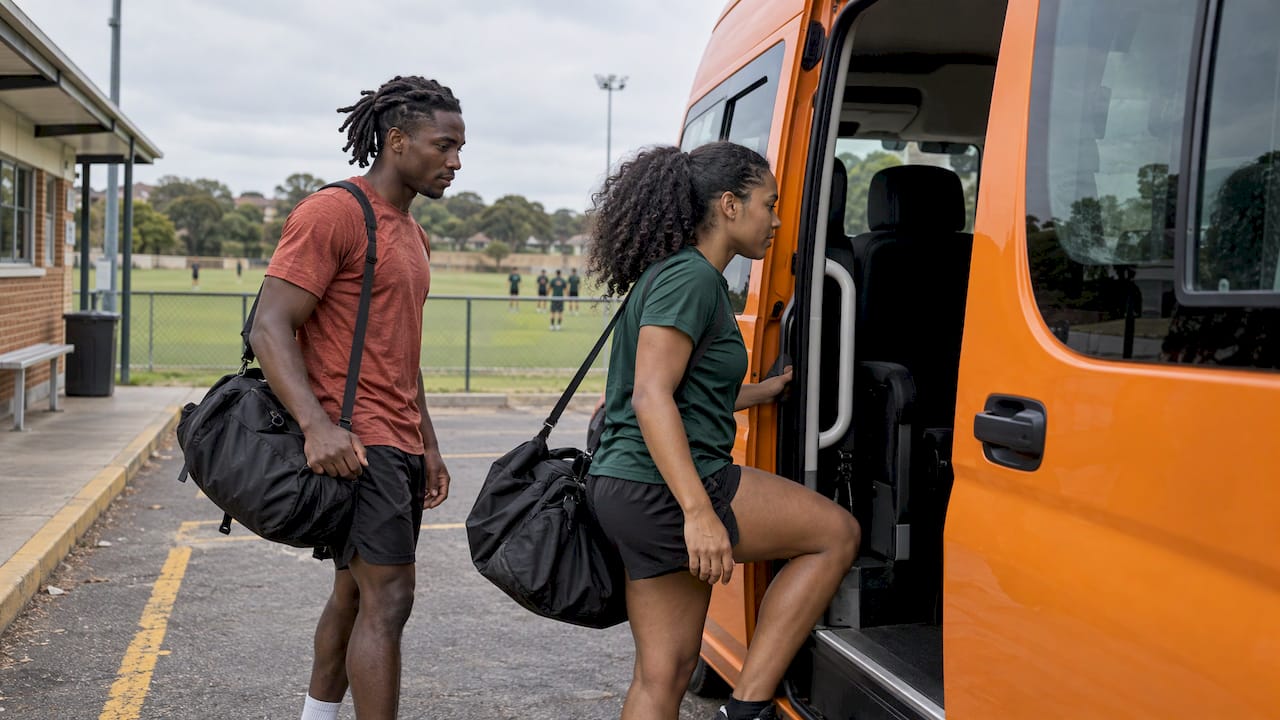
Good sports team transport comes down to three things: the right vehicle for your squad and kit, a pickup and arrival plan built around the venue, and a driver and vehicle you can vouch for. If you manage a team in Gauteng, a pre-booked, fixed-fare shuttle with licensed drivers covers all three. At A2B Shuttle we run event transport for concerts and sports from Johannesburg, with a fleet that runs from sedans to 22-seater buses.
This guide is for coaches, team managers, school sports coordinators and club organisers who have to get people to training, matches and tours on time and safely.
TL;DR
- Match the vehicle to the squad and the kit: a sedan for two or three staff, a minibus or a 22-seater for a squad.
- Plan backwards from kick-off: arrival window, drop-off point, parking and the return leg, in writing.
- Insist on a driver with a PDP (professional driving permit), a roadworthy vehicle, insurance and written references. Youth teams carry extra duties.
- Ask for a VAT-inclusive, fixed quote that spells out waiting time, so the budget does not move on the day.
- Book early for big fixtures: stadium roads are controlled and drop-off zones are limited.
Table of Contents
- What team transport actually involves
- Choosing the right vehicle
- Plan the match day backwards from kick-off
- Safety checks before the team gets in
- What team transport costs
- How to book team transport, step by step
- Our view: plan the whole trip, not just the bus
- Book your team’s transport with us
- FAQ
- Sources
What team transport actually involves
Most people picture a coach on match day. In practice, team transport is a chain of small movements: staff from the airport, players to training, a squad to a venue across town, the kit, and everyone home again.
Even at elite level the logistics are wider than the match. SASCOC’s Operation Excellence programme, according to its 2020–2021 annual report, counts transport to and from training sessions as a direct support service for athletes, next to living expenses, medical aid and access to training facilities. If transport is that central to a national programme, it deserves a proper plan at club and school level too.
For a typical team you are solving four problems:
- Getting there on time. Late arrival costs warm-up time and can cost a forfeit.
- Fitting everyone and everything. Players, bags, balls, bats, medical kit.
- Safety. Licensed drivers, maintained vehicles and, for minors, a clear chain of responsibility.
- Cost control. A budget that survives traffic, waiting time and a late finish.
Choosing the right vehicle
Start with headcount and equipment, then add a margin. A squad of 15 players plus two staff and kit bags does not fit in two sedans without splitting the group, and a split group arrives at different times.
A rough way to think about it:
| Group | Typical vehicle type | Watch for |
|---|---|---|
| 1 to 3 (coach, physio, visiting official) | Sedan | Airport pickup with a name board and flight tracking |
| 4 to 10 | Minibus or people carrier | Space for bags on the same trip |
| 11 to 22 | Larger bus, up to 22 seats | Seats left over for kit and staff |
| Several teams or supporters | Multiple vehicles with one coordinator | One departure time, one meeting point |
Our fleet ranges from sedans to 22-seater buses, so one booking can cover the head coach’s airport arrival and the squad’s trip to the ground. Tell us the headcount and the amount of luggage when you book so the vehicle is sized correctly from the start.
Two habits save a lot of trouble. First, count kit as passengers: a rugby squad’s tackle bags and a cricket team’s coffin bags take real space. Second, never plan a vehicle to 100% capacity. Someone always brings a friend or an extra bag.

Plan the match day backwards from kick-off
Build your timeline from the whistle, not from the departure time.
The roads and the venue
Big fixtures change how roads work. The City of Cape Town’s event transport management plan guidelines (May 2020) describe what a proper plan covers: routes, emergency and alternative routes, designated pick-up and drop-off zones, parking layouts and public transport arrangements. They also note that extra transport services for an event need temporary operating licences under section 60 of the National Land Transport Act. The same logic applies to any venue: ask the organiser where team vehicles may drop off and where they wait.
A real example of how much structure a major day has: for the August 2026 Springboks and All Blacks test in Cape Town, the City said its MyCiTi shuttle would run from five locations from 11:30, ahead of gates opening at 12:00, on a dedicated bus lane, with the last return shuttle leaving the stadium at 22:30, per its 23 August 2026 release. Public services like these are built for spectators. A team needs its own door-to-door plan so players are not queuing with the crowd.
For Johannesburg, FNB Stadium in Nasrec is the venue most teams and supporters ask about. We offer a fixed-fare Sandton to FNB Stadium shuttle, and our Soweto shuttle service covers FNB Stadium trips from that side of the city too.
A simple timeline
Work back from the time the team must be in the changing room:
- Changing-room time. Set by the competition or the coach.
- Drop-off buffer. Allow extra time for controlled roads and the walk from the drop-off point.
- Drive time. Check it at the same hour as the fixture, not at midday.
- Pickup time. Add a margin for late players. A departure time that is announced in advance, with a named person ticking off names, works better than one that is “around 10”.
- Return leg. Fix the pickup point and time now. Post-match crowds are the slowest part of the day.
For return journeys, agree where the vehicle will wait. When several groups travel to the same event, the organisers often set rules: at the 2025 MTN8 final in Mbombela, the traffic plan included a park-and-ride with buses and taxis leaving every 15 to 30 minutes and last buses leaving the stadium between 21:00 and 21:30. Team vehicles are not on those schedules, so confirm your own return time rather than assuming the public one.
Airport arrivals for touring teams
A visiting side flying into Johannesburg has a different problem: bodies, bags and jet lag after a long flight. We monitor flights so pickups match the real landing time, and our drivers meet you in the arrivals hall. Published fares from OR Tambo start at R736 to Sandton, R720 to Rosebank, R720 to Midrand and R1,119 to Pretoria, and from Lanseria to Sandton from R739. Airport waiting time is charged at R200 per hour, so a delayed baggage claim for a big group is a cost you can budget for. See our airport transfers for the full list.
Safety checks before the team gets in
This is the part that matters most, and it is easy to do properly.
The vehicle and the driver
Procurement documents show what South African organisations ask of transport suppliers. The Market Theatre Foundation’s 2026 transport tender asks for roadworthy vehicles, evidence of ongoing maintenance, short-term insurance and public liability insurance. Drivers must hold a PDP, be reliable and sober, and supply written references. It also wants detailed, VAT-inclusive costs, with prices valid for 120 days.
That list works as your own checklist:
- Roadworthy certificate and evidence of regular servicing.
- Insurance that covers passengers and business use.
- A driver with a valid PDP, the permit required to carry paying passengers.
- Written references.
- A quote that is VAT-inclusive and itemised.
Our drivers are PrDP-licensed, our vehicles are inspected regularly and we pay our drivers directly. If your own club vehicle is making the trip, a pre-trip vehicle inspection checklist is a useful way to cover tyres, brakes and fluids before a long drive.
Youth and school teams
If children are travelling, the rules tighten. Cricket South Africa’s safeguarding policy sets a clear standard for arranged team transport: a driver whose full driving licence is more than five years old, a vehicle with up-to-date service records, suitable business-use insurance, a first aid kit, a registered breakdown service, seatbelts for every child, and no child left alone in the vehicle. It also requires every trip, even a day trip, to be cleared by the designated safeguarding officer with a completed trip checklist covering journey times, stopping points, licence checks, insurance and emergency procedures.
Those are cricket rules, but they are a sound template for any school or club. Send the transport details to your safeguarding officer or school management before the trip, not on the morning.
Medical cover at the venue
Transport is not the only safety layer. Cricket South Africa’s return-to-play guidelines from July 2020 asked for an advanced life support ambulance parked so a patient can reach hospital quickly. Whatever your sport, find out before the day where the ambulance stands and which route it would take, and tell your driver.
What team transport costs
There is no single price for “a team trip”. The cost depends on distance, vehicle size, waiting time and the hours involved. For a sense of how suppliers are asked to price, the Market Theatre Foundation’s baseline pricing schedule lists indicative trips by distance, such as 24 km from OR Tambo to Newtown, 5 km within Johannesburg and 60 km outside it, with per-km rates left for bidders to quote. That is the right way to think about it: know your distances, then ask for a total.
What moves your price:
- Distance and number of legs. A there-and-back with a wait costs more than two one-way transfers in some cases, and less in others. Ask for both.
- Vehicle size. A larger bus costs more to run but often costs less per head.
- Waiting time. Matches overrun. Our waiting time at the airport is R200 per hour, and you should agree the rate for any venue wait in advance.
- Payment method. Card payments carry a 4% processing fee on our booking page.
We publish fixed fares with no hidden fees, so the amount you approve is the amount you pay. For longer tours, our guide to long-distance shuttle prices explains what drives the figure.
How to book team transport, step by step
- Write down the headcount, kit and schedule. Include arrival times, venue, finish time and any stops.
- Pick the vehicle size from the table above, with a margin.
- Request an itemised, VAT-inclusive quote that includes waiting time.
- Confirm driver and vehicle credentials: PDP, roadworthiness, insurance.
- Send a single itinerary to the driver, the coach and the team manager.
- Name one contact on the day who answers the phone for everyone.
- Confirm the return pickup point and time before the final whistle.
If your club also moves staff or officials regularly, our event transportation guide shows how to plan for larger groups, and our staff transport services page covers recurring runs.
Our view: plan the whole trip, not just the bus
We started A2B Shuttle in 2016 and the lesson of more than 5,000 trips is simple: teams rarely lose time on the road itself. They lose it in the gaps, a pickup that was vague, a driver waiting at the wrong gate, a flight that landed early.
That is why we monitor flights for airport pickups, why our drivers meet and greet, and why we publish fixed pricing with no hidden fees. A manager with 20 people to move should not also be chasing a quote.
We pay our drivers directly, our drivers are PrDP-licensed and our vehicles are inspected regularly. For a team, that means the person at the wheel is accountable to us and you know who to call.
Our advice to every coach and organiser: book the whole movement as one plan, from arrival to the last drop-off, with one vehicle supplier and one point of contact.
simba
Book your team’s transport with us
We handle event transport for concerts and sports, airport transfers from OR Tambo and Lanseria, and larger group runs with vehicles up to 22 seats. Tell us your squad size, venue and times and we will quote a fixed fare. Start with our private and group transport page, or book directly through A2B Shuttle.
FAQ
How early should we book transport for a big match?
Book as soon as the fixture and squad size are confirmed. Stadium roads are controlled on big match days and vehicle availability tightens, so an early booking also gives you time to agree drop-off and return points.
Can one booking cover both the airport pickup and the match-day trips?
Yes. You can arrange airport transfers and the trips to the venue as one plan. We offer airport transfers from OR Tambo and Lanseria alongside group and event transport, so one supplier can cover both.
What should a driver for a youth team have?
At minimum, a valid PDP, a roadworthy and insured vehicle, and written references. Cricket South Africa’s safeguarding policy also asks for seatbelts for every child and a driver whose full licence is over five years old. Share the details with your safeguarding officer before travel.
Is the quote the final price?
Our fares are fixed with no hidden fees. Waiting time at the airport is R200 per hour, and card payments carry a 4% processing fee, so confirm these when you book.
Sources
- SASCOC Annual Report 2020–2021
- City of Cape Town: Event Transport Management Plan Guidelines
- The Citizen: Mbombela traffic plan for the MTN8 final
- Market Theatre Foundation: transport services tender 2026
- Market Theatre Foundation: baseline pricing schedule 2026
- Cricket South Africa Safeguarding Policy
- Cricket South Africa Return-to-Play Level 3 Guidelines
Comments are closed