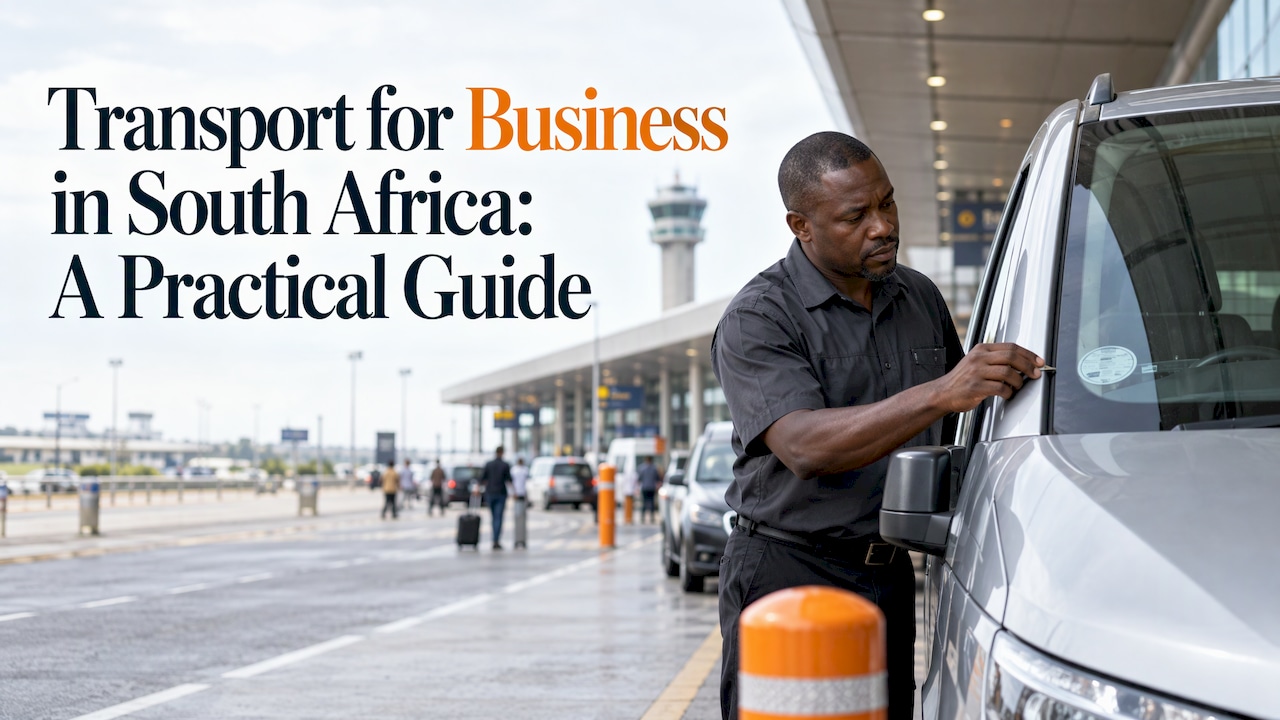
Transport for business, in the sense most companies need it day to day, means moving people safely and on time: executives from the airport, staff between sites, delegates to a conference, clients to dinner. The right choice is a licensed operator with permit-holding drivers, insured and roadworthy vehicles, a fixed fare agreed in advance, and a plan for flights, passenger numbers and luggage. This guide shows how to arrange that in Johannesburg and the rest of South Africa, what to check, and what drives the cost.
Freight and logistics are a different business with different rules. We cover that difference briefly below, then concentrate on passenger transport.
TL;DR
- Passenger transport for business means licensed shuttles, chauffeured cars and buses. Freight and trucking fall under separate rules.
- Anyone carrying passengers for reward needs a Professional Driving Permit, and the vehicle must be registered, licensed and roadworthy.
- Fixed fares, waiting-time rules and payment fees are the charges to confirm before you book.
- For airports and events, give the operator your flight numbers, headcount, luggage and timings so the vehicle fits the job.
- We run airport transfers, corporate and staff shuttles, conference and event transport in Johannesburg, with vehicles from sedans to a 22-seater bus.
Table of Contents
- What kinds of business passenger transport are there?
- Passenger transport versus freight: why the difference matters
- What to check before you book a shuttle
- Planning an airport pickup or corporate shuttle
- Arranging transport for a business event
- What affects the cost, and what to confirm in advance
- Staff transport and recurring corporate shuttles
- Building culture and downtime into a business trip
- Book business transport with us
- FAQ
- Sources
What kinds of business passenger transport are there?
Most companies end up using a mix of five services. Which one fits depends on how often you travel, how many people move together and how much control you need over timing.
| Service | Best for | Typical set-up |
|---|---|---|
| Airport transfer | Visitors, executives, returning staff | Pre-booked, fixed fare, driver meets the flight |
| Executive chauffeur | Senior staff, high-profile clients | Car or van with a dedicated driver, by the trip or by the day |
| Staff transport | Shift workers, site-to-site movement | Recurring routes and schedules, often a contract |
| Event and conference shuttles | Delegates, guests, wedding or concert groups | Loop between hotels and venue, or one-way group moves |
| Long-distance or tour trips | Client entertainment, team days out | Private vehicle for a day or a multi-day trip |
Public transport and ride-hailing can cover an occasional solo trip. They are harder to rely on when a group has to arrive together, when luggage is involved, or when a client expects a named driver at arrivals.
Passenger transport versus freight: why the difference matters
Search results for this phrase mix trucking firms and passenger operators, so it helps to be clear. Under the National Land Transport Act, a road-based public transport service means carrying passengers by road for a fare or reward, and nobody may run one without an operating licence or permit for the vehicle concerned. Goods vehicles follow a separate route under the National Road Traffic Act, with their own operator registration.
For you as a buyer, the practical point is simple: if people are travelling, ask passenger-transport questions. Which permit does the driver hold? Does this vehicle have an operating licence? Is there passenger liability cover? A freight company’s credentials do not answer any of these.

What to check before you book a shuttle
A professional-looking website is not a licence. These checks take a few minutes and protect your staff, your guests and your company.
Driver permits
Under the National Road Traffic Act, a person who conveys passengers for reward must hold a Professional Driving Permit (PrDP) and keep it in the vehicle. The same summary says the vehicle must be registered, licensed and display a valid roadworthy disc on the windscreen. Ask the operator to confirm all of this, and look for the disc when the vehicle arrives.
Accreditation and operating licences
The National Public Transport Regulator, part of the Department of Transport, is the body responsible for accrediting and licensing tourism transport operators. Operators need both accreditation, which speaks to being fit and proper with compliant vehicles, drivers and systems, and operating licences that authorise specific vehicles to carry tourists. The regulator’s own presentation says that from a date set by the Minister in the Gazette, tourist transport may only be operated by accredited operators, with accreditation renewed every five years. Ask any operator where it stands on this and keep a copy of the answer in your supplier file.
Insurance
SATSA’s guidance states that tourism transport operators must carry public passenger liability insurance for all vehicles used, and that each vehicle holds its own operating licence. Ask for the certificate, not just a verbal yes.
Tax clearance for contracted work
When a host city contracts event transport, the National Land Transport Act regulations list what it should verify: operator fitness, vehicle suitability and condition, registration and licensing, a valid SARS tax clearance certificate and drivers’ professional driving permits. A company contracting a shuttle supplier can use the same list as a sensible due-diligence checklist.
Use trusted, pre-arranged transfers
SATSA advises travellers to use reputable pre-arranged transfers and accredited members and to confirm recommended routes with their accommodation provider or tour operator. For a business, that translates into a written booking, a named driver and a confirmed pickup point rather than hailing whatever is available at arrivals.
Planning an airport pickup or corporate shuttle
Most problems with business transfers come from missing information, not bad drivers. Give the operator this when you book:
- Flight number and date. A driver who monitors the flight can adjust for early or late arrivals without anyone calling.
- Passenger count and names. A sedan, an executive van and a 22-seater bus are different jobs.
- Luggage. Count large bags, golf bags, display equipment or sample cases, not only people.
- Terminal and meeting point. At OR Tambo, international and domestic arrivals are in separate buildings, so state which one.
- Onward destination and any stops. A hotel drop is a different fare from a hotel plus a client site.
- A mobile number for the passenger and for your office.
If your visitor is connecting from an international flight to a domestic one, remember that the process involves clearing customs and re-checking bags. One itinerary guide suggests allowing at least 2.5 to 3 hours for it. That matters when you schedule a driver for the second leg.
A worked example
A team of six flies into OR Tambo for a two-day meeting in Sandton, with six suitcases and two laptop cases of demo kit. Six people with that much luggage will not fit one sedan comfortably. An executive 9-seater van takes the group and the bags in one move, the driver tracks the flight, and the fare is agreed before anyone leaves home. Compare that with three separate cars arriving at different times, three invoices and no one to brief the team on the way.
Arranging transport for a business event
Conferences, product launches, incentive trips and weddings add a layer: many people moving at the same time, to a venue with limited access. The City of Cape Town’s event guidelines are written for that city, but the checklist they set out applies well to any large gathering. It covers passenger movements, routes and traffic, venue access and loading zones, pickup and drop-off points, vehicle capacity, luggage or equipment, accessibility, signage, manifests, communications, a day-of coordinator and a backup plan.
The same document explains that in Cape Town a Transportation Management Plan must be submitted for approval where an event changes how road users drive, needs extra traffic control, causes abnormally long queues or affects public-transport routes. If your event is large enough to affect roads in your own municipality, ask the city whether it has an equivalent requirement before you finalise your transport.
For most corporate events the practical steps are:
- Count arrivals by hour and size the fleet for the peak, not the average.
- Fix a single pickup and drop-off point at each hotel and the venue, and tell the drivers where it is.
- Share a manifest with the operator so drivers know who they are collecting.
- Name one coordinator on your side and one on the operator’s side, both reachable on the day.
- Keep a spare vehicle or a clear rule for how extra capacity is called in.
Our conference transport service and hotel shuttles are set up around exactly this kind of loop between accommodation, venue and airport.
What affects the cost, and what to confirm in advance
Business transport pricing is easy to compare once you know which line items to ask about. These are the ones that change the final invoice:
- Route and distance. A short hop between Sandton and Rosebank costs less than a run to Pretoria.
- Vehicle size. A sedan, a 9-seater van and a 22-seater bus are priced differently.
- Waiting time. Flights run late and meetings overrun. Ask how many minutes are included and what happens after.
- Payment method. Some operators add a processing fee to card payments.
- Time of day and special requests. Early starts, late finishes, escorts and multi-stop itineraries can change the fare.
- One-off or recurring. Staff shuttles on a fixed schedule are usually quoted as an arrangement rather than a single fare.
Our published figures
Our airport transfer fares are published per trip. These are starting prices, and the booking page shows the fare for your exact trip:
| Route | Fare |
|---|---|
| OR Tambo to Sandton | from R736 |
| OR Tambo to Rosebank | from R720 |
| OR Tambo to Midrand | from R720 |
| OR Tambo to Pretoria | from R1119 |
| Lanseria to Sandton | from R739 |
Airport waiting time is R200 per hour, and card payments carry a 4% processing fee. Corporate, staff and event work is quoted to the job, so tell us about your requirement and we will confirm the price before you commit.
Staff transport and recurring corporate shuttles
If the same people make the same trip every day, a recurring staff shuttle often makes more sense than a string of one-off bookings. It gives you fixed pickup times, a known driver and a single supplier to manage. It also gives you one place to check permits, vehicle condition and insurance, instead of many.
When you set one up, agree on the following in writing: pickup points and times, what happens when someone is late, who is responsible for incident reporting, and how the vehicle is inspected. Our staff transport services and Sandton corporate shuttle pages describe how we run these.
Building culture and downtime into a business trip
Visitors on a business trip often have a free afternoon, and Johannesburg rewards it. One travel guide describes Johannesburg and Soweto as the cultural and historical centre, with the Apartheid Museum and Mandela House among the main sights. The same guide advises against being in the Johannesburg CBD at night and recommends hotel transfers for safety.
When you plan a tour into a business itinerary, agree the route, the stops and the return time with the operator in advance. Use a driver who knows the area, keep valuables out of sight and confirm routes with your hotel or tour operator, as SATSA advises. Our private transport and day tour options can be booked alongside the airport transfer so one supplier handles the whole visit.
Our view: reliability is a system, not a promise
We started in 2016, founded by a seasoned driver, and the lesson we keep relearning is that punctual, safe transport comes from habits, not slogans. We monitor flights so the driver is at arrivals when your guest lands. Our drivers are PrDP-licensed and we compensate them directly. Our fleet is inspected regularly, from sedans to a 22-seater bus.
For business clients we think the right question is not who is cheapest on one trip. It is who will still be on time on the fortieth. That is why we publish fixed fares, state our waiting and payment fees openly and keep no hidden charges. With over 5,000 trips behind us, we have seen that a clear brief and a clear price prevent most of the problems that make business travel stressful.
simba
Book business transport with us
We provide airport transfers from OR Tambo and Lanseria, corporate and staff shuttles, executive and VIP transport, and event and conference movements in Johannesburg and Sandton. For a team, the Executive 9-seater van and the 22-seater bus keep a group together with its luggage.
For a single traveller, see the OR Tambo and Lanseria transfer fares and book online or by phone. For regular or group work, start from our corporate shuttle services page and send us your routes, headcount and schedule.
FAQ
What is transport for business?
It is the movement of people or goods that a company arranges for its operations. For passenger needs this means airport transfers, executive cars, staff shuttles and event transport. Goods and freight are regulated separately from passenger services.
Do shuttle drivers need a special permit?
Yes. Under the National Road Traffic Act, a person who carries passengers for reward must hold a Professional Driving Permit and keep it in the vehicle. The vehicle must also be registered, licensed and display a valid roadworthy disc. Ask your operator to confirm both before you book.
What should I confirm about price before booking?
Ask for the fare in writing, how long waiting is free and what it costs afterwards, whether card payments carry a fee, and whether tolls or extra stops are included. With us, waiting time is R200 per hour and card payments carry a 4% fee.
How do I choose the right vehicle for a group?
Count passengers and luggage, not just heads. A small team with equipment cases usually needs a 9-seater van rather than two sedans, and a larger delegation or event loop suits a 22-seater bus. Share the numbers with the operator so they can recommend the fit.
Is a transport broker the same as a transport operator?
No. A broker arranges transport on your behalf with other providers, while an operator owns or runs the vehicles. Whichever you use, the vehicle and driver doing the trip still need the correct permits, licences and insurance, so ask to see them.
Sources
- Travellers Guide to SA: Tips and Requirements, SATSA
- Library and Tools, SATSA
- Legislative mandate of the National Public Transport Regulator, 2025
- National Road Traffic Act 93 of 1996 summary, Department of Tourism compendium
- National Land Transport Act regulation: matters to be checked by the host city
- Event Transport Management Plan guidelines, City of Cape Town
- Operating licences for freight and passenger transport in South Africa, Kweli
- 7 days in South Africa itinerary, Southafrica-spirit
- South Africa Travel Guide 2026, Packzup
Comments are closed